
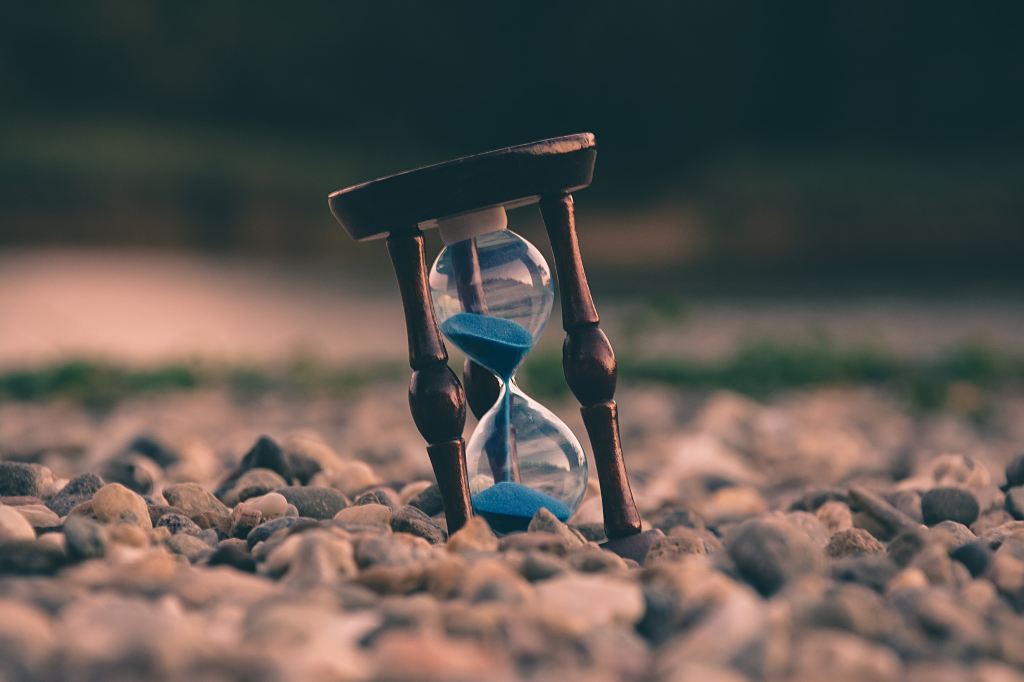
Time is limited – everyone knows this, and it is when resources are limited that people start to think about ways of managing it. You would be hard-pressed to hear that steps are being taken to manage our use of oxygen on earth (in a general sense), and this is because oxygen, as far as we know, is essentially unlimited (The strange history of atmospheric oxygen).
Knowing that a resource is limited, in my understanding, is the first step to ensuring proper management of the resource. As humans, limited by time, we each get an equal allotment of 24-hours per day (speaking in a general sense). How we choose to use this 24-hours, however, can really be what makes or breaks us.
Figuring out how best to use time (especially with respect to the goals that we have defined for ourselves) is, essentially, an unending quest. Even people who we venerate based on how efficiently we feel they use their time, are still on this unending quest for how to even better optimize their use of time – the quest never really ends (as far as I know). We are all at different points in the journey towards understanding our goals better and optimizing the time we have to, hopefully, meet these goals.
With all these being, said, we return to the focus on this specific post, ‘How do we better manage our time?‘ I believe the key to better managing our time is encompassed by the following points, below:
- Know how much time you have: While this might sound obvious, this is actually the first and most important step to proper time management. How much time do you have? Not necessarily in a general sense (like saying 24-hours), but more in subjective sense. There are portions of your day that go to reasonably non-negotiable activities like sleeping, as an example. The non-negotiables differ from person to person, with some persons having more non-negotiables, and some having less. For me, as an example, time for eating (3-times a day) is a non-negotiable for me each day. Knowing this, the question becomes, “What are the negotiable/available time periods I have left?” These are the ones that you need to focus on and optimize, based on your unique goal.
- Know why you need to have proper time management in the first place / Know your goal: Knowing why you need to have proper time management, in the first place, is what would be your driving factor (your fire) to ensuring that you are properly optimizing your time. You can’t be lax about this. There are several studies and articles (such as this one by LifeHack: What Is Goal Setting And Why Is It Important?) that clearly emphasize the importance of goal setting. Having a clearly defined goal helps you concentrate your actions towards achieving the said goal, it fosters resilience, it drives you to work harder, and it helps you reflect on your current state and compare against your preferred future state. Ideally, we should all have unique goals for doing whatever we do, so this is not something you can imitate. An example of a goal could be, “I want to better manage my time so that I am able to carve out some time to actively involve myself in volunteering activities“.
- Know / Remember all the tasks you need to attend to: To optimize/manage your use of time, you need to know what you are optimizing it for, practically. You need to know and REMEMBER what exactly you need that time for, in the first place. This aspect is what most people tend to find difficult. If you do not remember all the items you need to get done during the day, you would eventually not feel fulfilled at the end of the day, when you realize that you still have outstanding items that you, very possibly, could have attended to if only you had remembered them. If I have 10 tasks that require just an hour to handle, and I have 10-hours of usable time, but I, sadly, forget 4 of those tasks, I would eventually spend the 10-hours on the 6 I remember and maybe on other non-helpful activities. When I then remember, perhaps at the end of the day, that I still have 4 outstanding items, I would not feel like it was a well-spent day. The robustness of our memory could, many times, be something beyond our control, so for those who find that they tend to forget more times than they would prefer, having a diary or journal or some other way to remind yourself of your daily or periodic tasks could go a long way to helping ensure you attend to them in a timely fashion.
- Determine what tasks are a ‘Must have’, and what tasks are a ‘Nice to have’: Not every task is a dealbreaker. Some tasks don’t need to be completed right away (especially if there are other more pressing ones), so knowing which is more important at a given time and prioritizing those over the less important ones is a key element to proper time management. I’d give an example, if I had 1-hour, and I had 3 tasks (with context) that required an hour to handle; doing laundry (but I won’t be running out of clothes for the next 4 days), completing my assignment at the library (assignment is due the next day), and doing groceries (I still have food for the next 2+ days); it is automatically clear that one of those tasks was more of a ‘must have‘ than the others. The others were more or less like ‘nice to have‘. It becomes clear, automatically, what I should be allotting that 1-hour to. While this might be a simple example, it paints the necessary picture that alludes to this particular point.
- Learn how to optimize how you approach each task: While the aforementioned 4 points help us know how to better delegate time, this last point helps us learn to squeeze out more from every unit of time we have available to us. Assuming you have a task that takes 1-hour, normally, and you have just an hour, if you approach that task without considering how exactly you might optimize the performance of the task, you would probably just end up using the entire 1-hour for the task. This is not bad – it’s important to note that, however, if you figure out a possibly more optimized way to approach the same task, you might find that you end up using less time to complete the task; maybe 45-minutes, maybe less. I’d give an example; supposing I needed to prepare for work during winter, and I decided to iron my clothes, first (15-minutes), then boil some water for tea/coffee (7-minutes), then turn on my car and allow it to heat up sufficiently (5-minutes). If I approached those tasks sequentially, I would end up taking about 27-minutes in total. However, if I boiled water for tea/coffee, and turned on my vehicle to heat up in parallel, while ironing my clothes, I eventually could end up cutting the 27-minute time to about 19-minutes or less. This is optimizing the approach for the task. Optimizing the approach for each task, however, requires good organizational skills, which is understandable that not everyone would have.
What do you think about this topic? Do you feel you have good time-management skills? Are there more points you would add to what has already been outlined?
PS: Be the first to know about any content published on this blog-site by subscribing at the bottom of this page!

 Experiences of journeying humans